
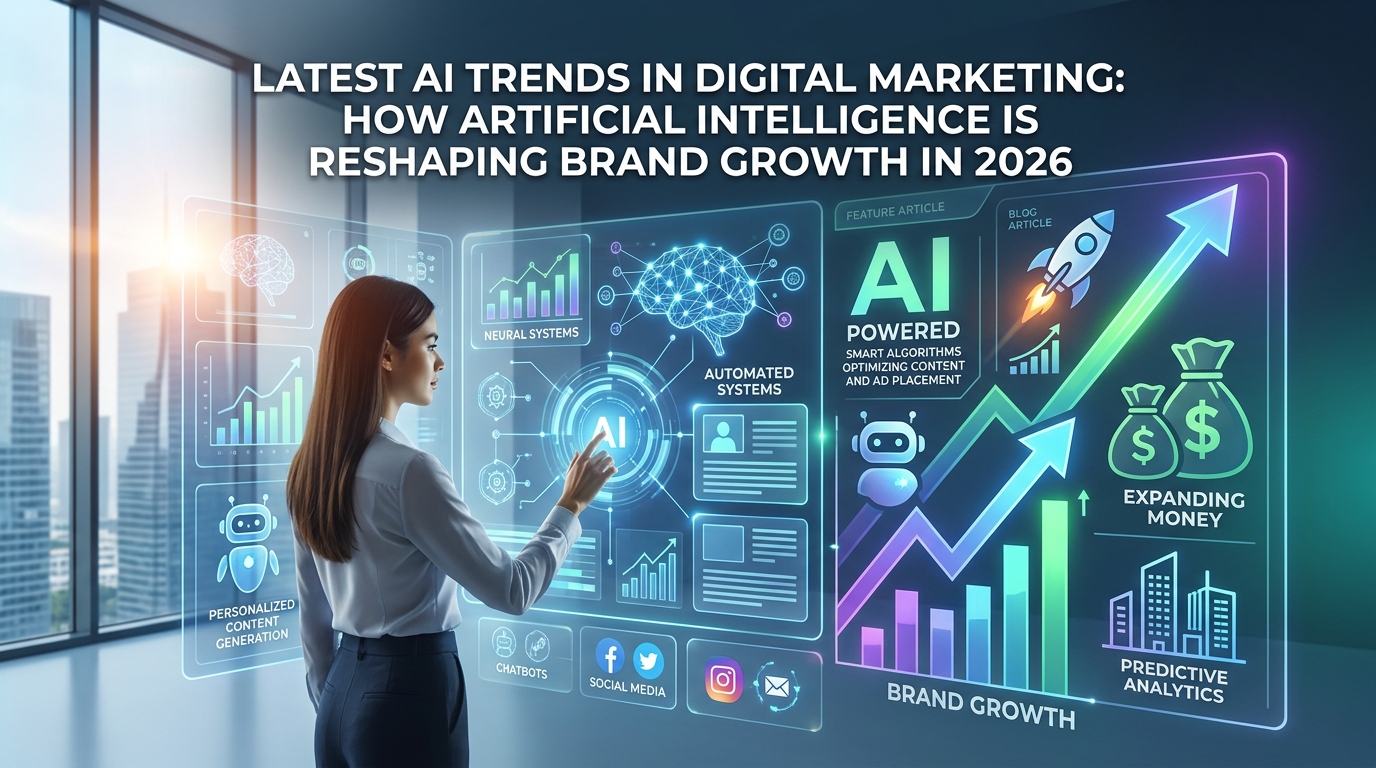
Artificial Intelligence (AI) is no longer a futuristic concept—it has become a core component of modern digital marketing. From personalized customer experiences to automated content creation and predictive analytics, AI is transforming how brands connect with their audiences. As businesses compete in an increasingly digital landscape, understanding the latest AI trends is essential for staying ahead of the curve.
In this article, we explore the most impactful AI trends shaping digital marketing in 2026 and how businesses can leverage them to drive growth, improve efficiency, and create meaningful customer experiences.
1. Hyper-Personalization at Scale
Consumers today expect brands to understand their preferences, behaviors, and needs. AI-powered algorithms analyze vast amounts of customer data to deliver highly personalized content, product recommendations, email campaigns, and advertisements.
Instead of segmenting audiences into broad categories, AI enables marketers to create individualized experiences in real time. This level of personalization increases engagement, improves customer satisfaction, and drives higher conversion rates.
Benefits:
- Improved customer retention
- Higher engagement rates
- Increased sales and conversions
- Better customer experience
2. AI-Generated Content Becomes Mainstream
Content creation has undergone a significant transformation with the rise of advanced generative AI tools. Marketers are now using AI to assist in creating blog articles, social media captions, ad copy, email campaigns, video scripts, and product descriptions.
While human creativity remains crucial, AI helps streamline content production by reducing time spent on research, ideation, and drafting.
Popular Applications:
- Blog writing assistance
- Social media content generation
- Ad copy optimization
- Video script development
- Content repurposing across platforms
3. Predictive Analytics for Smarter Decision-Making
AI-driven predictive analytics allows marketers to forecast future customer behavior based on historical data. Businesses can identify potential buying patterns, customer churn risks, and emerging market trends before they happen.
By anticipating customer actions, brands can allocate budgets more effectively and launch campaigns with greater confidence.
Key Advantages:
- Better campaign planning
- Improved audience targeting
- Enhanced ROI
- Reduced marketing waste
4. Conversational AI and Advanced Chatbots
Modern AI chatbots have evolved far beyond simple question-and-answer systems. Powered by natural language processing (NLP), today’s conversational AI can understand context, provide personalized responses, and handle complex customer interactions.
Businesses are increasingly deploying AI assistants on websites, messaging platforms, and customer support channels to provide instant assistance 24/7.
Benefits:
- Faster response times
- Reduced support costs
- Increased customer satisfaction
- Improved lead generation
5. AI-Powered Search and SEO Optimization
Search engines are becoming smarter with AI-driven algorithms that prioritize user intent, content quality, and relevance. Traditional keyword stuffing is no longer effective.
Modern SEO strategies focus on creating valuable, user-centric content supported by AI-powered optimization tools that analyze search trends, content gaps, and ranking opportunities.
Emerging SEO Trends:
- Intent-based optimization
- Voice search readiness
- Semantic search strategies
- AI-assisted content optimization
- Search experience enhancement
6. AI in Video Marketing
Video continues to dominate digital marketing, and AI is making video production more accessible than ever. Businesses can now use AI tools for script generation, automated editing, voiceovers, subtitles, and personalized video experiences.
AI also helps marketers analyze viewer behavior to optimize future video campaigns.
Common Uses:
- Automated video creation
- AI voice generation
- Dynamic video personalization
- Performance analytics
7. Programmatic Advertising Gets Smarter
AI has become the backbone of programmatic advertising. Machine learning algorithms analyze user behavior, demographics, browsing patterns, and purchase intent to place ads more effectively.
This automation allows marketers to deliver highly relevant advertisements to the right audience at the right time while maximizing advertising budgets.
Results:
- Better ad targeting
- Lower acquisition costs
- Higher click-through rates
- Improved campaign performance
8. Voice Search and AI Assistants
The growing adoption of voice-enabled devices is changing how consumers search for information online. AI-powered virtual assistants are influencing search behavior and creating new opportunities for marketers.
Brands are increasingly optimizing content for conversational queries and natural language searches to capture voice search traffic.
Optimization Tips:
- Use conversational language
- Focus on question-based content
- Optimize for local searches
- Improve website speed and mobile performance
9. AI-Driven Customer Journey Mapping
Understanding the customer journey has become more complex as consumers interact with brands across multiple channels. AI helps marketers track and analyze these touchpoints to gain deeper insights into customer behavior.
This enables businesses to create more effective marketing funnels and improve the overall customer experience.
Benefits:
- Better audience insights
- Enhanced customer retention
- More effective marketing strategies
- Improved conversion paths
10. Ethical AI and Data Privacy
As AI adoption grows, businesses must prioritize transparency, data security, and ethical AI practices. Consumers are becoming increasingly aware of how their data is collected and used.
Successful brands will be those that balance personalization with privacy while maintaining trust and compliance with evolving regulations.
Best Practices:
- Transparent data collection policies
- Responsible AI usage
- Secure customer data management
- Compliance with privacy regulations
The Future of AI in Digital Marketing
AI is no longer a competitive advantage—it is rapidly becoming a necessity. Businesses that embrace AI-driven strategies can improve efficiency, create more personalized customer experiences, and make data-backed decisions that drive growth.
However, the most successful marketing strategies will combine the power of AI with human creativity, emotional intelligence, and strategic thinking. Technology can automate processes and uncover insights, but authentic storytelling and brand building remain fundamentally human.
As AI continues to evolve, marketers who adapt early and invest in learning these technologies will be best positioned to thrive in the future of digital marketing.
Final Thoughts
The digital marketing landscape is undergoing a major transformation driven by artificial intelligence. From content creation and customer engagement to predictive analytics and personalized advertising, AI is reshaping how brands connect with consumers.
At Kreative Palette, we believe that embracing innovation is the key to sustainable business growth. By integrating AI-powered marketing strategies with creative excellence, brands can unlock new opportunities and stay ahead in an increasingly competitive marketplace.
Ready to future-proof your digital marketing strategy? The time to embrace AI is now.